The STEWART project aims at establishing a Science-based environmenTally friEndly neW lAyout foR floaTing PV, by preserving land resources and positioning FPV structures in inland waters and near-shore areas, this project aligns with the European Green Deal and the clean energy transition. The project is founded by CETPartnership and co-founded by the European Union.
Sustainable, cost-effective photovoltaic technology is essential for fully decarbonized power generation, the European Green Deal, and a successful energy transition. Within the STEWART project, an interdisciplinary, international team is developing a science-based, environmentally friendly concept for floating photovoltaic systems for onshore and nearshore deployment that integrates ecological, economic, and regulatory aspects. This work is grounded in monitoring and simulating system performance during operation and in analyzing interactions with the water body, including light availability, cooling, and pollution. The project also examines the effects of potential soiling of PV modules by bird droppings and evaluates suitable mitigation measures.
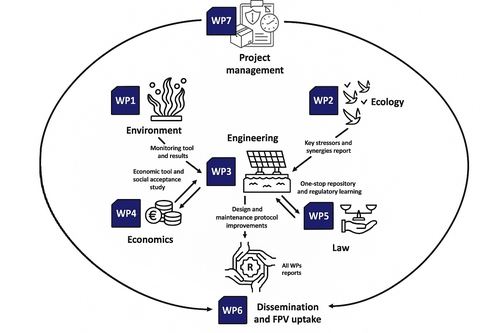
The STEWART project has seven specific main objectives:
WP1: Environmental monitoring and modelling of lakes and FPV
Further development of a method for assessing the interaction between water bodies and the environment; technical monitoring of PV performance, PV modules, and water bodies (including reference to water bodies and birds).
WP2: Water birds and floating PV – ecology and key stressors
Bird watching and key ecological stressors; development of a tool for automatic pollution detection and implementation of an experimental mitigation study for biotic pollution parameters (especially in relation to birds), including a demonstrator.
WP3: Design methodologies and operational maintenance protocol improvement
Development of a design catalog and guideline for sustainable, nature-compatible FPV installations; formalized design principles, improved maintenance protocols, and novel KPIs for environmental friendliness; improvement measures based on the experience of industry partners.
WP4: Socio-economic viability and Impacts assessment
Consideration of ecological and economic aspects of a sustainable FPV concept; strategy to reduce maintenance costs and improve system performance (decrease in unplanned maintenance interventions).
WP5: Legal observatory and regulatory learning
Organized collection of experiences, information, and studies on legislation at European and national level; inclusion of legal framework conditions as a basis for policymakers.
WP6: Reporting and knowledge community
Organized collection of experiences, information, and studies to support reporting and the knowledge community.
WP7: Project management
Management of the project.
Four locations for floating PV systems across Europe were selected to cover a wide range of climatic and aquatic conditions. From quarry ponds and drinking water reservoirs to alpine hydropower and near‑shore ocean locations, these installations allow us to evaluate FPV performance, environmental interactions, and technical reliability in contrasting real‑world environments.

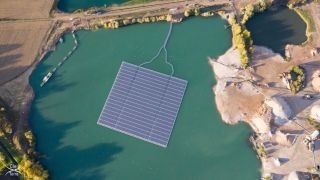
The Leimersheim site in Germany is a 1.5 MWp floating PV system installed on a mesotrophic quarry lake in a continental humid climate. This case study investigates energy yield, the interaction with water quality in a former gravel pit, and the technical performance of FPV under moderate Central European conditions.

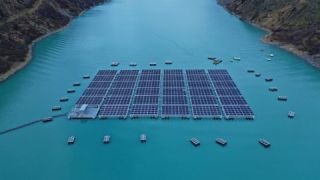
At Lac des Toules in Switzerland, a 0.45 MWp floating PV array operates on an oligotrophic high‑altitude hydropower reservoir at 1,808 m. The site allows us to study FPV performance in harsh alpine conditions and its integration with existing hydropower infrastructure.

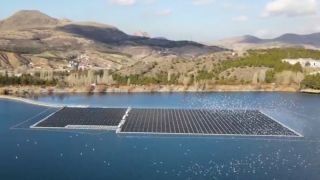
The Bayindir Dam installation near Ankara in Turkey is a 1.0 MWp floating PV plant on an oligotrophic freshwater reservoir in a continental arid climate. Here we assess FPV performance under high solar irradiance, limited water availability, and the implications for drinking‑ and irrigation‑water management.

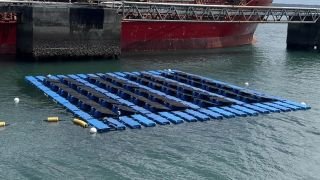
In Brest, in France, a 0.025 MWp floating PV system is deployed in a near‑shore maritime environment. This case study focuses on the behaviour of FPV under wave and tidal influence, corrosion and biofouling challenges, and the potential of ocean‑based floating solar in coastal regions.
The project is carried out in collaboration with an international consortium of research, industry, and academic partners, including Fraunhofer ISE, Tonucci & Partners, HelioRec, INNOSEA, Middle East Technical University, Sapienza University of Rome, and the EGE University.

In addition, the project is supported by further partners who contribute their expertise from the fields of energy supply, water management, legal services, industry associations, and academia. These supportive partners are Romande Energy (CH), Ankara Water and Sewerage Administration General Directorate (ASKI) (TR), KONTEK (TR), Schellenberg Wittmer (DE), Erdgas Südwest (DE), Industrieverband Steine und Erden Baden-Württemberg e.V. (ISTE) (DE), MIRO – Bundesverband Mineralische Rohstoffe e.V. (DE), and the University of Western Macedonia (GR).
> STEWART Workshop in Ankara: 01/2027 – more information will be available soon
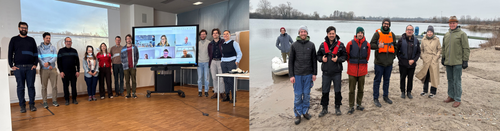
The STEWART consortium held its 5th project meeting on 2-3 February 2026 at Fraunhofer ISE in Freiburg, Germany. Partners reviewed progress across all work packages, from environmental monitoring, bird ecology and FPV design methodologies to socio-economic assessment, legal aspects, and dissemination and joined an excursion to the Leimersheim gravel lake FPV site to discuss next steps on site.
Stay up to date with our latest news, project insights and events. Visit us on LinkedIn and follow our page for regular updates and behind-the-scenes impressions.
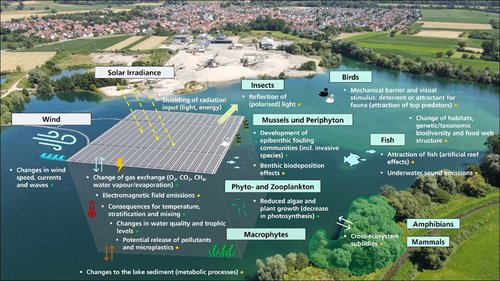
Ecological interactions of floating PV with lake ecosystems
The picture summarizes the main pathways through which floating photovoltaic (FPV) systems can influence lakes. By partially covering the water surface, FPV arrays modify light penetration, surface heating, wind-driven mixing and gas exchange at the air-water interface. These physical changes can propagate through the water column and affect water quality, nutrient dynamics and biological communities such as plankton, macrophytes and fish, as well as shoreline habitats and recreational use.

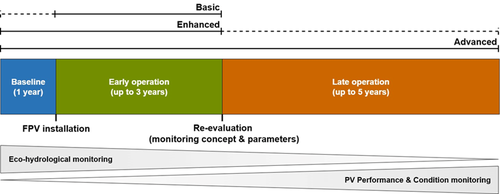
Three-level environmental monitoring concept for floating PV on lakes
Within the STEWART project, a three-level environmental monitoring concept was developed to assess the impacts of floating photovoltaic (FPV) systems on lakes. FPV installations on inland waters must comply with instruments such as the Environmental Impact Assessment Directive and the Water Framework Directive, but empirical evidence on their ecological effects is still limited and existing projects often use different parameters and methods.
The concept therefore structures monitoring into three tiers: Basic, Enhanced and Advanced and three project phases baseline, early operation and late operation.

Monitoring intensity and parameter coverage are scaled to site sensitivity and project goals: from core eco-hydrological measurements for baseline characterization and trend detection, to more detailed, process-oriented and research-driven setups that resolve physical, chemical and biological interactions between FPV systems and lake ecosystems.
> Ilgen, K., Bresson, T., Graef, A., Sirch, E., Baltins, K. (2026): Standardized FPV Monitoring for Inland Water Bodies and Nearshore - in Preparation